On this page:
Key details
| What | Details |
| Eligibility | Currently enrolled PhD students at one of the following universities:
Australian National University (ANU)
University of New South Wales (UNSW)
University of Tasmania (UTAS)
Note: Eligibility requirements may vary depending on the applicant’s home university. Any additional eligibility conditions will be outlined in the application guidelines for each internship round. |
| Intern Scholarship | Interns receive a scholarship payment as part of the program. Details will be outlined in the application guidelines for each internship round. |
| Duration | 3 months full-time (or part-time equivalent) |
| Schedule | Full-time is 35 hours/week. Whether working full- or part-time, the intern is expected to work mostly during regular business hours (9 am–5 pm AEST/AEDT with a 1-hour lunch break). Flexible work arrangements are also available by agreement. |
| Full-time vs part-time | Full time is preferred but part-time is also considered. |
| Location | Canberra-based interns are expected to work at the ACCESS-NRI office on ANU campus (Building 69, 5 Liversidge Street, Acton), with some flexible options available.
Interns based outside Canberra are expected to work remotely within Australia. |
| Travel support for approved on-site visits or events: | Interns based in Canberra will have a budget to cover approved transport and accommodation expenses for an ACCESS-related workshop, conference, or event. Budget amounts can be found in the application guidelines.
Canberra will have a budget to cover approved transport and accommodation expenses for on-site visits to the ACCESS-NRI office in Canberra (for example, a 6-week visit or two 2-week visits) or attendance at an ACCESS-related workshop, conference, or event. Budget amounts can be found in the application guidelines. |
| Equipment | Intern must provide their own computer, ideally a laptop that can be used when working on site at the ACCESS-NRI building.
Desk space with internet connection will be provided while interns are on site at the ACCESS-NRI building. |
What can you expect as an intern?
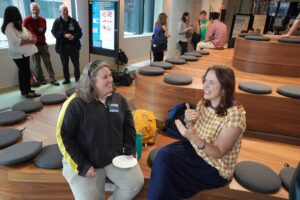 This internship provides hands-on experience in research software engineering in a supportive and collaborative environment, designed to help you grow your skills and confidence. You will work closely with ACCESS-NRI staff on a project that supports the development, testing, documentation, and/or release of climate modelling software and data.
If selected, you’ll be matched with a project and mentor(s). There is space to tailor a project to your individual interests and professional goals, as you will have the opportunity to negotiate the project’s scope, milestones, and timeline during the project planning stage.
Most ACCESS-NRI staff are based in Canberra, but around a third work remotely across Australia. You will be encouraged to interact with ACCESS-NRI staff and potentially other interns, through a mix of in-person and online interactions. You will also have the opportunity to participate in our monthly all-staff meetings, weekly skillshare sessions (where staff share a skill or topic of interest), as well as other relevant meetings and activities (such as team or other technical meetings).
At the end of the internship, we will ask you to present what you learned at a skillshare session, submit a short summary report, and take part in an exit interview.
What’s in it for you?
Your day-to-day tasks will vary depending on your project, interests, and background. Through the internship, you may gain experience and skills including:

A visualisation of wind in the region around Australia using ACCESS-ESM1.6 data. Visualisation credit: Owen Kaluza.
- An understanding of what climate models are and how they work
- Technical experience running and developing climate models and producing climate model output
- Experience using high-performance computing environments
- Insight into what it’s like to work as a research software engineer in a non-academic setting
- Applying software development best practices, which may include:
-Git/GitHub for version control and collaborative coding
-Continuous integration (CI) and continuous deployment (CD)
-Debugging and testing
-Software documentation
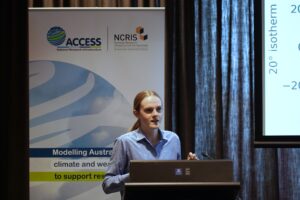 Read previous interns experiences at ACCESS-NRI:
Lindsey Oberhelmen’s internship journey
Paula Boubel’s internship journey
Jemma Jeffree internship journey
Claire Yung internship journey
Skills you might have
If you have any of the following skills, we encourage you to apply!
This list is meant as a guide only, so if you aren’t sure whether you have the background to apply, please reach out to discuss this further.
- Climate-related research
- Computational research
- Software development
- Coding or data best practices
- Data management and analysis
How to apply
Full instructions will be provided in the application guidelines for each internship round.
Applications should include:
Short-listed candidates will be invited for an interview with ACCESS-NRI.
Selection process
Step 1: Application review
Each application will be reviewed and scored against the selection criteria using a standard rubric by all members of the review panel.
Applicants who best meet the selection criteria will be shortlisted for an interview.
Step 2: Interviews
Shortlisted candidates will be interviewed by the review panel. Interviews will be assessed using the same selection criteria and rubric.
Step 3: Final selection
Final selections will be made based on both the written and interview performance. Successful applicants will be notified via email.
Review panel
The review panel will assess both written applications and interviews and will consist of at least 3 members, including:
- Internship Program Lead
- At least one additional ACCESS-NRI staff member
- At least 1 external member, such as:
- ACCESS community member (who is not ACCESS-NRI staff)
- Previous intern
- A representative from another research software engineering–related institution
Evaluations of applications
Applications will be reviewed and scored by the review panel using a consistent rubric across all selection criteria. Each criterion is assessed on the quality and clarity of the applicant’s response.
Scoring Levels:
| Scoring levels | Points | What it means |
| Strong | 16-20 | The response clearly demonstrates strong engagement, depth of understanding, and insight. The applicant provides specific examples and communicates their ideas clearly. |
| Good | 9-15 | The response addresses the criterion well, with relevant examples or explanation. Shows understanding and engagement, but with less depth, clarity, or reflection than a strong response. |
| Limited | 1-8 | The response partially addresses the criterion but lacks detail, clarity, or relevance. May be vague, underdeveloped, or demonstrate limited engagement with the topic. |
| Not Addressed | 0 | The criterion is not addressed. |
How Scoring Works:
Each selection criterion (and, if relevant, interview question) is scored independently, then summed for an overall application score.
The scoring is designed to evaluate applicants fairly based on the content and clarity of their responses, rather than, e.g., the number of opportunities they have had.
If you have any questions, please contact the Internship Program lead at training.access.nri@anu.edu.au
Or join for one of our info and Q&A sessions:
Disclaimer
partner

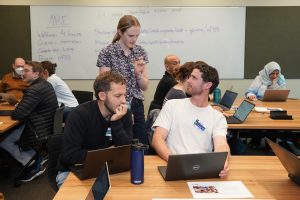 The ACCESS-NRI PhD Internship Program offers PhD students hands-on experience in a professional research software environment. Interns work alongside ACCESS-NRI staff on activities related to the development, testing, and release of climate models as well as the supporting software and data that underpin them. The program is designed to support students from a range of backgrounds, helping to build technical skills, professional confidence, and experience working in a collaborative, non-academic setting.