
July 3, 2026
 This week, all around the country, we are celebrating 20 years of the National Collaborative Research Infrastructure Strategy (NCRIS).
Celebrations included an event at Parliament House on Monday, morning teas around the country on Tuesday to celebrate the people who power NCRIS, and a full day Symposium in Canberra on Tuesday.
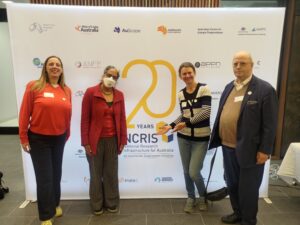
Some of the ACCESS-NRI participants at the NCRIS Symposium. l-r: Claire Carouge, Natalia Bateman, Heidi Nettelbeck, Paul Leopardi
One thread ran through every celebration: NCRIS is a unique initiative, unlike anything else in the world. We simply cannot tackle the huge challenges before us,in health, environment, manufacturing and beyond, without collaboration. Without NCRIS, many of the innovations and research breakthroughs this country has produced would never have happened.
Australia’s climate simulator, ACCESS-NRI, joined the NCRIS family in 2022, a family of 27 infrastructures powered by experts spanning every scientific discipline, where collaboration and community sit at the heart of how we work together.
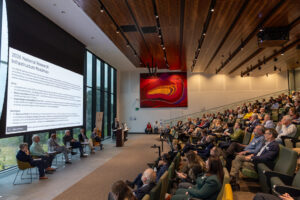
the NCRIS Symposium
The best description of NCRIS came from Professor Mahananda Dasgupta, who called it the orchestra that allows the soloist to shine. It’s a fitting image: NCRIS players (experts) play their instruments (microscopes, submarines, climate modelling software, data, telescopes and more). Sometimes the whole orchestra plays together, sometimes just the strings, and when they do, they create the kind of music that lets researchers do their best work. As the representative from the Department of Education noted, NCRIS gives researchers what they need to benefit us all, powering connections and unlocking access to resources.
On Tuesday, morning teas were held across the nation to celebrate the incredible research infrastructure people who have enabled, and will continue to enable, NCRIS’s successes.
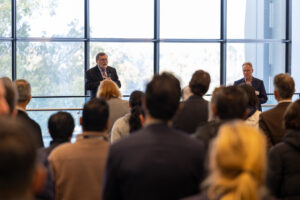
Australia’s Chief Scientist, Professor Tony Haymet
As Australia’s Chief Scientist, Professor Tony Haymet, who joined the Canberra celebrations put it: NCRIS is one of the finest examples of something that simply works in Australian research, and it’s essential that it continues into the future.
The Symposium opened with Professor Fiona Wood, a striking example of what is possible when researchers have access to world class infrastructure and the freedom to collaborate across disciplines, from curing burn injuries to transforming patient care.
To close the day, Professor Ian Chubb, who facilitated the final panel, offered a simple but powerful reminder: “excellent research requires excellent infrastructure. To make good decisions, we need research. To do research, we need research infrastructure. And without it, we cannot hope to meet our commitments, here at home or on the world stage”.
 Watch a video of the NCRIS celebrations