
November 11, 2026
In short: Taking part in the Coupled Model Intercomparison Project (CMIP) is crucial to Australia’s ability to prepare for climate change. A new CMIP7 Dashboard from NESP and ACCESS-NRI now tracks our experiments as they are completed, giving an up-to-date view of our contribution. Here we explain why it matters.
Climate change will shape the homes we live in, the food we grow, and the risks we face from bushfires, floods and heatwaves. Decisions about where we build, what we plant and how we prepare for disasters rely on climate projections, and those projections are only as good as the climate models underneath them.
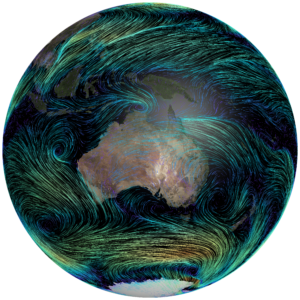
Visualisation of wind around Australia using data from ACCESS-ESM1.6
The Coupled Model Intercomparison Project (CMIP) brings together climate scientists from around the world to test and compare the computer models used to understand and project our climate and how it is going to change with increasing greenhouse gases. This is the seventh phase of the project, known as CMIP7, with more than 40 centres expected to contribute
CMIP is coordinated by the World Climate Research Programme and its results feed directly into the Intergovernmental Panel on Climate Change (IPCC) assessment reports, which underpin climate policy and decision-making worldwide.
Australia’s contribution to CMIP is the Australian Community Climate and Earth System Simulator (ACCESS) model, developed through a large collaborative effort involving researchers and software engineers from multiple institutions and fields of expertise.
At a national level, participating in CMIP7 is crucial. All our national and state climate projections trace back to a subset of CMIP global models, downscaled for Australia. ACCESS is the only CMIP model built in Australia and tailored to Australian conditions, so ensuring it is part of those ensembles means decisions about our future rest on science designed for our region. Through ACCESS, Australia brings a crucial Southern Hemisphere perspective the global ensemble would otherwise lack. Participation also means our models, and the experiments of the Australian research community, are evaluated alongside those of other centres worldwide.

The ACCESS-ESM1.6 Model
As Monash University Professor Julie Arblaster remarks “CMIP7 is not only about feeding information into the Intergovernmental Panel on Climate Change (IPCC), but it is also essential for national climate and risk assessments and climate information at that regional and local scale”.
“Participating in CMIP leads to hundreds of research papers worldwide that use ACCESS. Taking part in CMIP is how Australian science gets into the global evidence base, and how Australia gets access to dozens of other nations’ models in return,” says Professor Andy Hogg, Director of ACCESS-NRI.
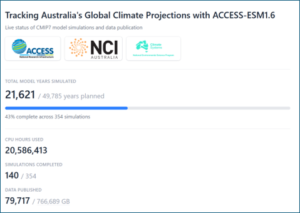
CMIP7 Dashboard
CMIP7 will take years to complete, but anyone can now follow Australia’s simulations as they progress, and see the data as it is published, on the new CMIP7 Dashboard. This dashboard tracks the progress of Australia’s experiments as they are completed, giving an up-to-date view of where our contribution to CMIP7 stands.
For CMIP7, Australia has already submitted the ACCESS-ESM1.6 model and plans to submit another model, ACCESS-ESM3.
ACCESS-ESM1.6, Australia’s newest Earth system model, simulates the atmosphere, oceans, land, sea ice and carbon cycle together, including Australian vegetation. It was developed by CSIRO and ACCESS-NRI, Australia’s climate simulator. The model runs on the National Computational Infrastructure (NCI) supercomputer, Gadi.
“The new ACCESS Earth system model delivers three key improvements over ACCESS-ESM1.5. These include a new version of the ocean biogeochemistry model, WOMBAT-lite; an enhanced version of the CABLE land surface model featuring new Australian specific vegetation types, broadly representing eucalyptus and acacia ecosystems; and modernised software infrastructure that improves model performance, accessibility and reproducibility,” says CSIRO’s Principal Researcher Tilo Ziehn, science lead and co-developer of the model.
What’s next
As CMIP7 progresses, ACCESS-ESM1.6 simulations will continue to be published, and ACCESS-ESM3 is expected to follow. Together they will feed into the IPCC’s next assessment and form part of the foundation for Australia’s next generation of national and state climate projections. Because the model’s data output is open to everyone, any Australian researcher can use the same version submitted to CMIP7 and build on the work behind it. When planners, farmers and emergency services weigh the risks of a changing climate, the evidence they rely on will include science built here, for Australian conditions.
Anyone can follow that contribution as it happens on the CMIP7 Dashboard, created by a collaboration between the National Environmental Science Program (NESP) Climate Systems hub and ACCESS-NRI.
Acknowledgements
ACCESS-NRI modelling relies on computational and data resources operated by Australia’s National Computational Infrastructure (NCI), located at the Australian National University. ACCESS-NRI and NCI are enabled by the Australian Government, Department of Education, through the National Collaborative Research Infrastructure Strategy (NCRIS). This project is a close collaboration between the National Environmental Science Project (NESP) Climate System Hub, CSIRO and ACCESS-NRI.