
Researchers are using the high-resolution ocean-sea ice model, ACCESS-OM, to follow dense water as it forms beneath Antarctic sea ice and cascades into the abyss. This hidden process shapes how the global ocean stores heat and carbon.
The Southern Ocean surrounding Antarctica plays a major role in forming the Earth’s deepest ocean waters. These waters then spread north into the Atlantic, Pacific and Indian Oceans, circulating through the whole planet. Because direct observations in this remote region are so limited, ocean models are one of the best tools for visualising how the process works.
“Our research explores how changes in Southern Ocean circulation impact global climate and what the future might hold,” says Dr Adele Morrison from the Australian National University (ANU). “We use an ocean model to simulate how the deepest ocean waters form and flow into the Southern Ocean.”
This visualisation shows a simulation produced with a high-resolution ocean model, ACCESS-OM. This powerful tool allows researchers to explore these incredible but hidden ocean realms, where direct observations are limited.
It all starts with intense surface cooling during the Southern Hemisphere winter. Freezing conditions near the Antarctic coast produce vast amounts of sea ice, and at its winter peak, the ice covers more than twice the area of Australia. As fresh sea ice forms, salt is rejected into the surrounding seawater. This makes the already cold water saltier, and therefore denser.
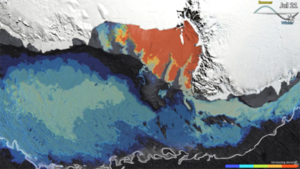
Caption: Dense, salty water (orange) building up beneath sea ice in the Ross Sea, as simulated by ACCESS-OM
These dense waters then spill off the continental shelf and cascade down the slope. They form underwater waterfalls that plunge up to 4 km below the ocean surface. In the abyss they become Antarctic Bottom Water, a cold, oxygen-rich water mass that spreads to fill more than half of the global ocean floor and helps drive the global overturning circulation.
“This higher-resolution simulation represents Antarctic Bottom Water formation more accurately than previous models,” says Dr Wilton Aguiar from ANU. “It allows us to examine rotating flows, known as eddies, and the waterfalls of dense water flowing off the continental shelf in incredible detail.”
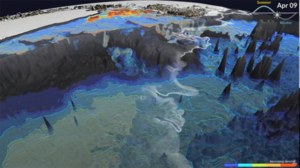
Dense water cascading off the Antarctic continental shelf into the deep ocean, as simulated by ACCESS-OM
Capturing these fine-scale processes matters, as there is now evidence that the formation of these dense waters is slowing as the climate warms. Dense water cascades strongly influence the long-term storage of heat and carbon in the ocean. They also affect marine biological productivity and help moderate the pace of climate change.
High-resolution simulations like this are computationally intensive. They rely on national research infrastructure: the ACCESS-OM model supported by Australia’s climate simulator (ACCESS-NRI), and supercomputing at the National Computational Infrastructure (NCI).
“We still have many questions about the far-reaching consequences of these changes for our planet,” says Dr Morrison. “High-resolution models are critical for discovering new insights into fine-scale processes, and their impact on global climate, in one of the most remote regions on Earth.”
Scientific publications related to this research:
Aguiar, Wilton; Morrison, Adele; Huneke, Wilma; Hutchinson, David; Spence, Paul; Hogg, Andrew; Colombo, Pedro; Stewart, Kial. (2025). Antarctic dense water formation sensitivity to ocean surface cell thickness. 10.22541/essoar.173557404.42900568/v2. https://doi.org/10.1029/2024MS004913
, , , , & (2025). Sensitivity of Antarctic Bottom Water formation and export to horizontal model resolution. Journal of Advances in Modeling Earth Systems, 17, e2024MS004621. https://doi.org/10.1029/2024MS004621
More about ACCESS-OM: https://www.access-nri.org.au/models/access-om/