
December 17, 2025
How well do climate models represent aerosols in the Southern Ocean?
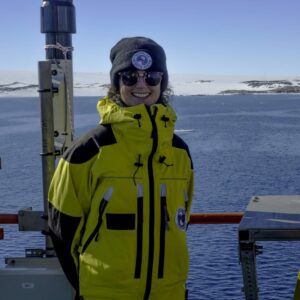
Profile photo of Dr Sonya Fiddes from the AAPP website.
A recent paper published in Atmospheric Chemistry and Physics explores the interaction between marine aerosols, clouds and radiation using ACCESS-AM2, which is the ACCESS Coupled Model version 2 (ACCESS-CM2), without the ocean component.
Read the article on the publisher’s website
To find out more about the research, I spoke with Dr Sonya Fiddes, a Research Associate for the Australian Antarctic Program Partnership (AAPP) at the University of Tasmania’s Institute for Marine and Antarctic Studies.
What is the motivation for this research?
Climate models applied at the Southern Ocean exhibit an effect called the Southern Ocean cloud radiation bias. Put simply, the clouds in these models don’t reflect enough sunlight into space and allow too much sunlight to reach the ocean surface. This effect impacts both the oceans and the global energy balance.
“What my work is trying to do is understand this bias and find ways to reduce it, so we can better model the global energy balance and the Southern Ocean climate.”
Is this cloud radiation bias a unique problem for the Southern Ocean?
This bias is present in other areas, but not to the same degree as the Southern Ocean. According to Sonya, it comes down to how the clouds are formed.
“A lot of the clouds in the Southern Ocean are what we call supercooled liquid water clouds. Even though the temperature is below zero degrees, the water in the clouds stays liquid. Because the Southern Ocean is such a clean and pristine place, you need an aerosol, which is a tiny particle that cloud droplets form onto. Particular types of aerosols allow water to freeze. If it’s not this type of aerosol, the water will stay as a liquid until it gets extremely cold.”
In the Southern Ocean, there aren’t many sources of aerosols that allow ice to form (called ice-nucleating particles). This means there are more liquid clouds, which are more reflective than ice clouds. For models like ACCESS-AM2, this poses a problem.
“Our models think there are a lot more ice clouds than liquid clouds, which is allowing too much sunlight to reach the surface. They also get the cloud amounts wrong, too.”
The research compares modelled and observed cloud condensation nuclei. What are these?
“An aerosol is any tiny solid or liquid particle in the air. They grow to be of a size that we call ‘cloud relevant’—they need to grow to a particular size for water to be able to condense onto—and then they become cloud condensation nuclei. Then there’s a question about whether those particular aerosols can also nucleate ice or not.”
This paper doesn’t specifically focus on the phase problem of ice versus liquid clouds and instead considers the aerosol cloud condensation nuclei number.
How are cloud condensation nuclei numbers modelled with ACCESS-AM2, and how are they measured in the field?
ACCESS-AM2 has an aerosol scheme called the Global Model of Aerosol Processes (GLOMAP). It’s a bimodal aerosol scheme in that it models both the aerosol size and number. For the Southern Ocean, it simulates aerosols coming out of the ocean, including sulfate aerosols and sea spray aerosols.
In the field, an instrument called a cloud condensation nuclei counter is used. It sucks in air, heats it until the water vapour reaches a particular supersaturation, then counts the number of aerosols that have water condensed on them to form a droplet.
“The beauty of this work is that it uses ship campaigns. On the Research Vessel (RV) Investigator, it measures cloud condensation nuclei as part of its routine measurements. That instrument is always on the ship. For these particular campaigns, the data has been properly quality-controlled and published. That’s why, for the first time, we were able to use a fairly large sample of observations to get both a large latitudinal and seasonal breakdown of cloud condensation nuclei number.”

Field observations used in the study. Image from Figure 2 of Fiddes et al. (2025).
What are the main challenges for modelling aerosols in the Southern Ocean?
“A lot of problems in our models come about because we haven’t had observations. The clouds have been parameterised based on what we assume for the Northern Hemisphere, which doesn’t work in the Southern Hemisphere. So, for the clouds, it’s often assumed that there’s enough aerosols or enough of the ice-nucleating aerosol for ice to form. Whereas we know in the Southern Ocean that’s not the case, and that’s why we’re seeing these problems.”
However, Sonya is positive about the increasing observation sample size resulting from vessels like the RV Investigator.
How were the experimental simulations for the research chosen?
The paper consists of eight different experimental simulations. Sonya explained how it began as coauthor Liam Lamprey’s honours project, with just one or two experiments. It then organically evolved as more questions were raised and tested, with some being sparked by conference discussions.
“There were a few things we knew we had to test, like a new climatology for the aerosols derived from dimethyl sulfide. We wanted to test how well that performed.”
What were the main findings of the research?
Sonya highlighted two main findings.
“The first one is the experiment that we were most happy with, which used the updated dimethyl sulfide climatology and turned on the production of another type of aerosol, the primary marine organic aerosol. They had an incremental improvement in the Southern Ocean radiation bias. It didn’t solve the problem, but it showed a small improvement.”
The region where the biggest changes were, particularly for dimethyl sulfide climatology, was the sea ice region around Antarctica.
“We know that there are some missing sources of aerosol in that region. So that says to us that if we work a bit harder here and try and include some more of these missing sources in the model, we might see an even better improvement.”
The other main finding was related to sea spray. For this experiment, sea salt was tied to wind gusts rather than wind speed. This increased the cloud condensation nuclei towards observations, although it still underestimated the aerosols compared to observations.
“But then that had huge downstream impacts on the clouds and the radiative bias in regions that we didn’t really want to change, which is not unexpected. It said to us that if we are going to try to fix the cloud condensation nuclei for the Southern Ocean, which includes regions outside of that sea ice zone, this might need to be done hand-in-hand with looking at the cloud microphysics and the aerosol microphysics.”
What does this mean for future atmospheric models?
“I have just gotten access to the ACCESS-AM3 configuration docs. I know they’ve got the primary marine organics turned on in there, but I want to test it with the new dimethyl sulfide climatology and hope that it has the same result and recommend that it might be used instead.”
Sonya also encourages those doing similar research to make contact.
“If anyone is looking at cloud microphysics or aerosols, even in other parts of the country, feel free to reach out, because we’ve dived pretty deep into those schemes now.”
Reference
Fiddes, S. L., Woodhouse, M. T., Mallet, M. D., Lamprey, L. J., Humphries, R. S., Protat, A., Alexander, S. P., Hayashida, H., Putland, S., Miljevic, B., & Schofield, R. (2025). The ACCESS-AM2 climate model underestimates aerosol concentration in the Southern Ocean; improving aerosol representation could be problematic for the global energy balance. Atmos. Chem. Phys., 25(22), 16451–16477. https://doi.org/10.5194/acp-25-16451-2025