
February 10, 2026
Australia’s ability to understand and plan for climate risk depends on access to high-quality climate models, high-performance computing to run the models, and the effectiveness of the infrastructure that connects them. In a recent advancement, Australia’s climate simulator (ACCESS-NRI) released an adapted regional model, ACCESS-rAM3, to enable regional-scale climate and weather research across the nation.

The ACCESS-rAM3 model
Regional models like ACCESS-rAM3 offer greater detail than global models. These models show local-scale processes critical for understanding extreme weather, water security and climate change impacts in Australian communities. Localised projections give scientists, policy-makers and communities a clearer picture of how short- and long-term climate change will play out in their regions, supporting better planning and resilience.
Localising climate information through an international collaboration
Originally developed by the UK Met Office, the model data pipelines have been adapted to the Australian supercomputing context by ACCESS-NRI’s data and software engineering experts. ACCESS-NRI principal research software engineer, Dr Chermelle Engel, said the decades of work by the Met Office were a privilege to use.
‘If the UK Met Office hadn’t developed this incredible model, we wouldn’t have the ability to do this regional modelling.’
To produce Australian projections, the UK model was configured to run on climate data curated and hosted by the National Computational Infrastructure (NCI) and executed on NCI’s high-performance computing systems.
‘You cannot run this model on a laptop. It has to run on a supercomputer,’ Chermelle said. ‘If Australian researchers did not have access to NCI, they would not be able to use this state-of-the-art model.’
Access for all
True to its name, ACCESS-NRI is providing far greater access to climate data than ever before, thanks to its ongoing partnership with NCI.
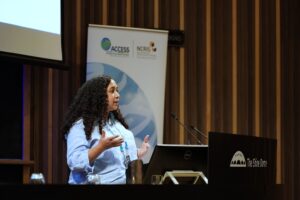
Dr Chermelle Engel at the ACCESS Workshop 2024
‘Access to supercomputing is essential to the work we do. Through NCI, PhD students don’t have to pay for the data and the modelling capability,’ Chermelle said.
Dr Mathew Lipson, a senior researcher at the ARC Centre of Excellence for 21st Century Weather, UNSW Sydney, also highlighted how this access translates into research efficiency and national capability.
‘Ten or twenty years ago, it used to take more than 3 months to set up and start a model to undertake modelling experiments,’ he said. ‘In contrast, two weeks ago, I was able to take some PhD students with no model experience and get them to run ACCESS-rAM3 within a couple of hours.’
ACCESS-rAM3 is deliberately designed to use existing NCI-hosted data sets. Instead of researchers downloading terabytes of data, everything they need is already available on the same system where they run the model. Having a central platform avoids duplication, reduces cost, and ensures that even new users, including PhD students, can conduct sophisticated analyses with only a laptop and an NCI account.
Invisible power
Despite its impact, much of the technical work enabling this capability remains behind the scenes. Chermelle emphasised that the strength of the ACCESS-NRI and NCI collaboration lies in seamlessly removing complexity for users.
‘The power of our infrastructures is that when we – ACCESS-NRI and NCI – do our job right, scientists can focus more on their research, and less on the technical details of the model,’ she said.
An ongoing partnership
This partnership between ACCESS-NRI,NCI and researchers from the Centre of Excellence for 21st Century Weather, demonstrates how shared national capabilities can accelerate research by reducing duplication and improving data management. It allows Australian researchers to both contribute to and benefit from global advances in climate science, as well as high-performance computing and data, while also helping Australian communities prepare for the impacts of climate change.
Chermelle said the teams are investigating connecting the ACCESS regional model to the Australian-developed land-surface models and working on extending the infrastructure’s capability to undertake longer climatic data runs, over months, years, and decades.
This article first appeared on www.nci.org.au. To read the original, go to:Clarity on climate change: NCI supports localised Australian climate simulations | NCI