
February 10, 2026
Australia’s latest climate model, called ACCESS-ESM1.6, is now ready to enter the global stage through the Coupled Model Intercomparison Project (CMIP7), which will inform the next Intergovernmental Panel on Climate Change (IPCC) report.
Read more about the importance of the Australian submission
In this story, we explore how reaching this milestone has required what we call “collaboration infrastructure”. For a project like submitting ACCESS-ESM1.6 to CMIP7, collaboration isn’t just helpful—it’s the technical backbone of climate research itself.
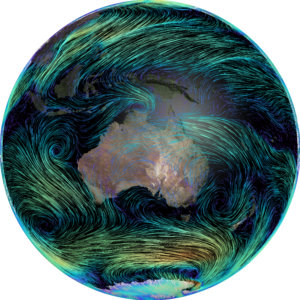
A visualisation of wind in the region around Australia using ACCESS-ESM1.6 data. Visualisation credit: Owen Kaluza.
ACCESS-ESM1.6 simulates Earth’s climate system, including the atmosphere, oceans, land, sea ice, and biological processes. ACCESS-ESM1.6 is a major collaborative effort involving multiple teams across CSIRO, Australia’s climate simulator, ACCESS-NRI and Universities. Without this close partnership between researchers and software engineers working together to ensure that complex natural processes are accurately represented in code and implemented reliably and efficiently, the vital bridge between scientific discovery and global climate action wouldn’t exist.
“The number of things that must be done along the way for a project like this is pretty incredible and involves many people including almost all of the ACCESS-NRI teams. Compared with the submission for CMIP6, this time we are making much better use of collaboration infrastructure, to help ensure our results are reproducible and traceable. It’s not only a matter of getting the individual components like the atmosphere, land and ocean models working well together, but also setting up the correct model inputs and processing the output to meet CMIP standards,” says Martin Dix, Associate Director for Model Development at ACCESS-NRI.
For CMIP7, all participating models must reach a stable, balanced state—a process called spin-up— before they can be used to make future projections. ACCESS-ESM1.6 is in the final stage of this spin-up so it is ready to enter the project and meet the strict deadlines of the “CMIP7 Assessment Fast Track”, maximising the possibilities of the research being included in the IPCC report.
“Participating in this global program is vital for Australia as it ensures Australian science informs global climate policy, with our model benchmarked for reliable use worldwide. As a leader of climate modelling in the Southern Hemisphere, Australia brings a unique and crucial global perspective,” says CSIRO’s Senior Principal Research Scientist Rachel Law, coordinator of the CMIP7 project in Australia.
This is also a collaborative effort between National Research Infrastructures. Climate models use supercomputers to solve the complex equations needed to make climate projections. ACCESS-ESM1.6 uses the National Computational Infrastructure (NCI) ‘Gadi’ machine. Without this collaboration, there wouldn’t be an Australian submission for CMIP7.
This new version of ACCESS-ESM1.6 incorporates an additional decade of climate data since CMIP6, adding new knowledge of the carbon cycle, which includes Australian vegetation, land use change and improved ocean biology.
“One key new feature of ACCESS-ESM1.6 for the land surface model component brought together CSIRO, universities and ACCESS-NRI to better represent vegetation over Australia. We changed the vegetation distribution to correspond better to what comes from satellite observations, broadly representing two types of trees: one mostly eucalypt and one mostly semi-arid acacia, which come with their own traits in terms of water use,” says Claire Carouge, team lead of the Land modelling team at ACCESS-NRI.
“This type of project is impossible without collaboration. While people can work on different elements of the model individually, you eventually need to bring them together because the system has feedbacks between components that you can only test by collaborating. When you integrate everything, those feedbacks change how the individual pieces work together,” she says.
On the technical side, this project demonstrates the value of ACCESS-NRI’s release infrastructure.
“The ACCESS-NRI have enabled improved reproducibility, traceability and visibility for ACCESS-ESM1.6 simulations while providing the infrastructure so researchers can run the model themselves. This opens new research possibilities as we address important questions for Australia on how we mitigate and adapt to a changing climate,” says CSIRO’s principal researcher Tilo Ziehn, science lead and co-developer of the model.
Finally, other essential components of this collaboration infrastructure are trust and enthusiasm:
“None of this happens without trust—trust in the process, trust that changes researchers make are being properly tracked and reflected, and trust that the work will lead to a good outcome. When everyone feels confident that the pace is right, not too fast, not too slow and that contributing and using the models is easy, the project just works,” says Aidan Heerdegen, leader of the ACCESS-NRI Release team.
“The collaboration succeeded because everyone was genuinely ready to work together. People were willing to hand over responsibility where it made sense and equally willing to take it on where needed and people were very enthusiastic to be part of this process”, notes Dr Claire Carouge, who coordinated the project from the ACCESS-NRI side.
It is often highlighted that National Research Infrastructures comprise not only the instruments, and facilities or software, but also the experts who maintain and enable researchers to use them. We argue that collaboration should also be considered infrastructure. As we demonstrated with the collaboration that resulted in ACCESS-ESM1.6 being included in CMIP7, without all the elements involved in a collaboration, this type of project is simply impossible.
The CMIP7 submissions are being led by CSIRO with support from the Australian Government National Environment Science Program (NESP) Climate Systems Hub and Australia’s climate simulator (ACCESS-NRI), the national research infrastructure in charge of maintaining and releasing the models.
ACCESS-NRI and NCI are enabled by the Australian Government, Department of Education, through the National Collaborative Research Infrastructure Strategy (NCRIS).