
May 4, 2026
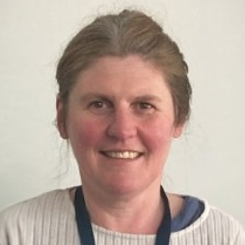
Profile photo of Dr Alison Bennett
In this conversation we speak with Dr Alison Bennett, an R+ Postdoctoral Research Fellow at CSIRO.
Where did you grow up, and how did you become a climate researcher?
My path to research was long and winding. I grew up in Melbourne and developed a keen interest in both science and the environment from an early age. During high school, I learned about the ‘greenhouse effect’ and from there developed a concern about climate change. This concern expanded into an overarching concern about the environmental impacts of human activity. So when I moved on to study Arts and Science at Monash University, I selected subjects with environmental aspects. After graduation, I worked in several small businesses that delivered environmental sustainability programs and, over the years, gradually moved into management roles, eventually managing the operations of a small software development company.
In 2015, reflecting on my career, I realised it was headed in the wrong direction. I wanted my work to positively impact the environment and to mitigate the impacts of climate change. And I wanted to work in science. I returned to study at Melbourne University, completing a Masters (Environment) degree and then a PhD, where my research focused on how climate change affects Australia’s forests. From there, I became a CSIRO R+ Postdoctoral Research Fellow, where I am currently working.
Which ACCESS models/configurations do you use and what do you use them for?
I use the CABLE land surface model to simulate the effects of climate change on Australia’s future carbon cycle. CABLE is the land surface model embedded within the ACCESS Earth System Model, ACCESS-ESM, and I use a branch (CABLE-POP) and configuration (BIOS3) of that model that runs in an offline (i.e., no climate feedback) mode. This configuration is optimised for Australia.
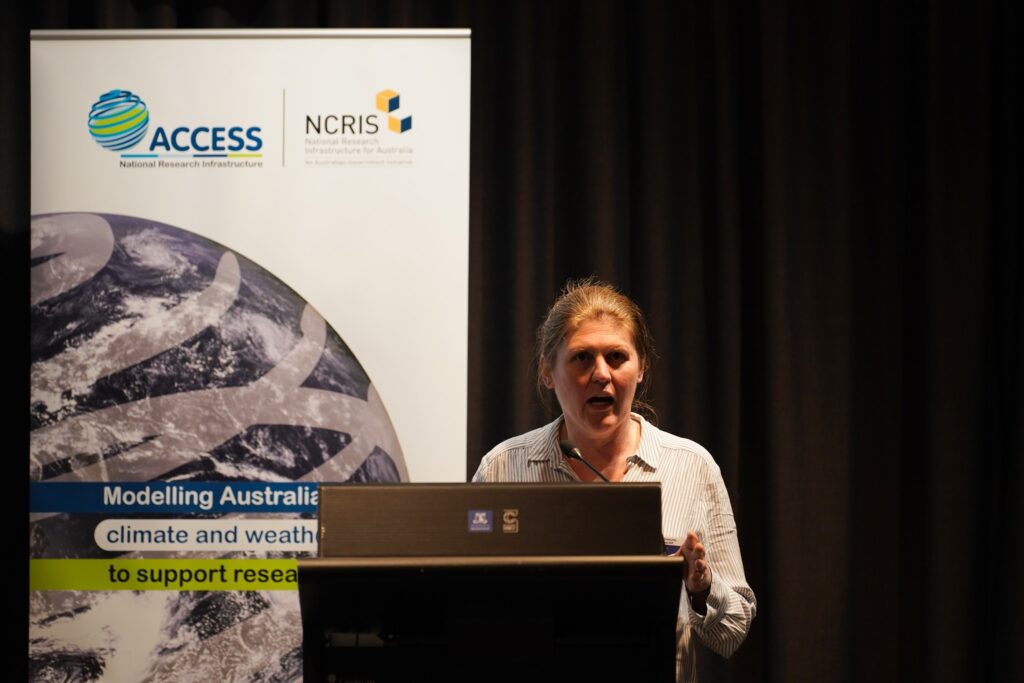
Alison Bennett presents her research at the 2025 ACCESS Community Workshop
I run continental-scale simulations (~25km grid) using climate data from seven CMIP6 models under two future emissions scenarios. I then analyse the output in various ways to estimate Australia’s total carbon uptake over time under different climates, to determine where uptake is likely to increase or decrease, and to attribute any changes to individual climate drivers. Our group also plans to examine how fire and scenarios of land-use change will affect Australia’s carbon cycle in the future.
What is the focus of your research, and what excites you about your work?
My research is focused on understanding the future of Australia’s terrestrial carbon cycle under scenarios of climate change. With Australia’s commitments to net-zero under the Paris Agreement, it’s important that we understand the range of potential land carbon cycle responses to alternative climate futures. My work develops baseline estimates of continental carbon uptake that can help with the planning and placement of nature-based carbon removal solutions.
Most of my work excites me! I have landed exactly where I hoped to be when I embarked on retraining 10 years ago. It is fulfilling. It is challenging. I am passionate about the subject, and the work has potential for impact. Importantly, I get to work with smart, interesting people who care about similar things to me.
What do you like to do outside of work?
Outside my work at CSIRO, I work on other things – either bringing up my three small children, working in the garden, renovating the house or helping in the family business. I love doing all these things. But you probably mean “what are my hobbies or interests”? These days, there is no time for hobbies, but when there is spare time, I like to take walks, hunt out fresh produce at farm-gates, read dystopian non-fiction, listen to podcasts, and dream about the days I will have time to have a hobby again…