
February 2, 2026
Profile photo of Dr Rachel Law
In this conversation we speak with Dr Rachel Law, a Senior Principal Research Scientist at CSIRO.
Where did you grow up, and how did you become a climate researcher?
I grew up on the southern outskirts of London but completed my last 3 years of secondary school in Melbourne, when my dad’s work brought us here for a planned 3.5-year stay. Work took my parents back to the UK after 7 years, and I spent a year there with them between my undergrad and postgrad studies.
I chose meteorology as one of my first-year subjects in my University of Melbourne science degree and enjoyed the ‘real-world’ applications, which led me to climate science. In the early 1990s, Melbourne Uni ran its own atmosphere model, and I spent much of my PhD replicating the moisture transport in the model to transport passive tracers. This led to simulating the transport of atmospheric CO2 and inferring sources and sinks of CO2. I’ve worked on modelling the carbon cycle and climate ever since.
Which ACCESS models/configurations do you use and what do you use them for?
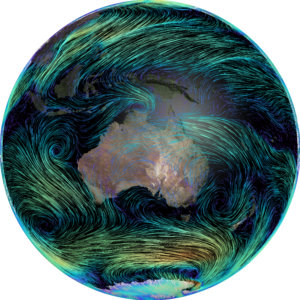
A visualisation of wind in the region around Australia using ACCESS-ESM1.6 data. Visualisation created by Owen Kaluza.
I mostly use the Earth System Model (ESM) versions of ACCESS: ACCESS-ESM1.5 and ACCESS-ESM1.6. These models are used for climate timescale simulations and have the capability to simulate the carbon cycle.
We can run the models either ‘concentration-driven’ or ‘emissions-driven’. When concentration-driven, the atmospheric CO2 is prescribed, and land and ocean carbon fluxes respond to that forcing but don’t directly impact the climate simulation. When ‘emissions-driven’, the simulation is forced with anthropogenic carbon emissions, and the atmospheric CO2 is simulated. In this mode, feedbacks between the carbon cycle and climate are captured in the simulation.
ACCESS-ESM1.5 was used for Phase 6 of the Coupled Model Intercomparison Project (CMIP6), while ACCESS-ESM1.6 is being developed for CMIP7. For CMIP7, the preference is for models to run future projections in emissions-driven mode.
What is the focus of your research, and what excites you about your work?
My research focuses on improving the land-atmosphere carbon simulation in ACCESS to enable exploration of future carbon pathways and the transition to net-zero emissions. I’m definitely an experimentalist at heart, so I am happiest when I can be hands-on running the model and digging through the model output.
One feature of our ACCESS simulations is that we routinely put our land and ocean carbon fluxes into the atmosphere as separate passive tracers, even when we aren’t running with fully interactive carbon. This means, for example, that we can test the impact of Australian carbon fluxes on simulated atmospheric CO2 at Kennaook/Cape Grim and assess how it compares with observations.
What do you like to do outside of work?
Sometimes there doesn’t seem to be much spare time beyond family responsibilities, though school years are now behind us, and we only have about 100 hours of learner driving supervision to get through! I am a leader with Girl Guides and help run a weekly meeting for about twenty 10–15 year old girls. It is satisfying to see the girls develop new life skills, particularly when we have the opportunity to go camping. Toasting marshmallows over a campfire at the end of the day and seeing a star-speckled sky is always a pleasure.